

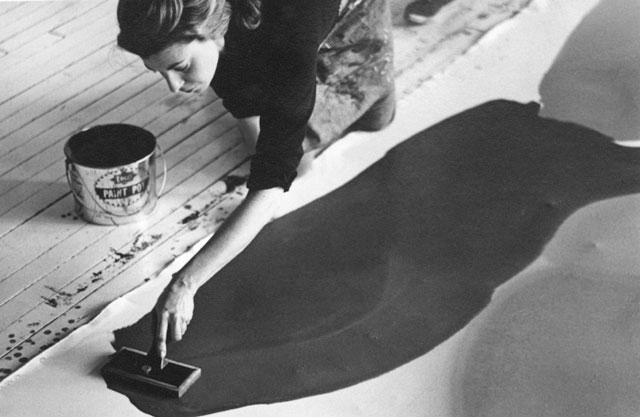




Joan Mitchell
 |
Low Water, 1969. Oil on canvas, 112 x 79 inches (284.48 x 200.66 cm). Carnegie Museum of Art |

One of Joan's favorite haunts, the smoke-and stale beer-perfumed San Remo had black- and- white tiled floors, a pressed-tin ceiling, a dark-mirrored bar, and a clientele that included James Agee, Miles Davis, Judith Malina, Tennessee Williams, and young New York poets. There painter Jane Freilicher used to observe Joan and Mike across the room--she in jeans and the talismanic long leather coat- smoking, drinking, huddling conspiratorially over a little table, and looking "very French New Wave."
 |
Untitled, 1961. Oil on canvas, 90 x 81 inches (228.6 x 205.7 cm). Collection of the Joan Mitchell Foundation, New York |
Although there is no specific place, nature is more ‘really’ present than in most representational paintings. It is because of the ‘reality’ of the details. The details, shaped like brushstrokes, have committed shapes, and the colors have committed texture, hue, and substance. They are not muddy, which has nothing to do with the presence or absence of browns or grays, but with their being clearly what they are. Miss Mitchell has been attentive to outside nature and her inner experience, and she gives you something real.


Subscribe to:
Posts (Atom)


 Posts
Posts

