
Showing posts with label artists. Show all posts
Showing posts with label artists. Show all posts

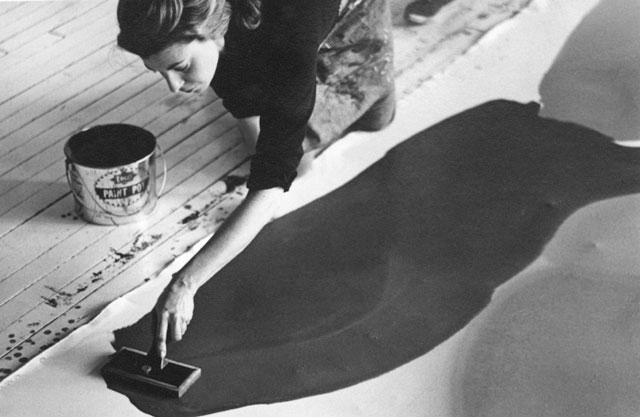

Joan Mitchell
 |
Low Water, 1969. Oil on canvas, 112 x 79 inches (284.48 x 200.66 cm). Carnegie Museum of Art |

One of Joan's favorite haunts, the smoke-and stale beer-perfumed San Remo had black- and- white tiled floors, a pressed-tin ceiling, a dark-mirrored bar, and a clientele that included James Agee, Miles Davis, Judith Malina, Tennessee Williams, and young New York poets. There painter Jane Freilicher used to observe Joan and Mike across the room--she in jeans and the talismanic long leather coat- smoking, drinking, huddling conspiratorially over a little table, and looking "very French New Wave."
 |
Untitled, 1961. Oil on canvas, 90 x 81 inches (228.6 x 205.7 cm). Collection of the Joan Mitchell Foundation, New York |
Although there is no specific place, nature is more ‘really’ present than in most representational paintings. It is because of the ‘reality’ of the details. The details, shaped like brushstrokes, have committed shapes, and the colors have committed texture, hue, and substance. They are not muddy, which has nothing to do with the presence or absence of browns or grays, but with their being clearly what they are. Miss Mitchell has been attentive to outside nature and her inner experience, and she gives you something real.


Today the artist is no longer constrained by the limitation that all of man's experience is expressed by his outward appearance. Freed from the need of describing a particular person, the possibilities are endless. The whole of man's experience becomes his model, and in that sense it can be said that all of art is a portrait of an idea.


r. rauschenberg


We [Rauschenberg and Jasper Johns) were the only people who were not intoxicated with the Abstract Expressionists. We weren't against them at all, but neither one of us was interested in taking that stance. I think both of us felt there was too much exaggerated emotionalism around their art... My first break was that nobody took me seriously, even though I hung out at the Cedar Tavern, and drove Franz Kline home when he was too drunk. Jasper wasn't taken seriously either, and I was considered a clown.
yves klein: color coding

THE MINUTE OF TRUTH
To all those intoxicated with the machine and the big city, to the frenetics of rhythm, masturbated by reality, YVES offers a highly enriching cure of asthenic silence • Far beyond the outpourings of other worlds, already so imperceptible to our common sense of the reasonable, somewhat removed, no doubt, from what is called "the art of painting," at the level in any case of the most pure and essential emotional resonances, are these rigorously monochrome propositions: each of them sets off a visual field, a colored space, stripped of all graphic transcription and thus escaping from time’s duration, devoted to the unified expression of a certain tonality • Over the heads of that convenient decoy, the average public, the old habitués of art informel will agree on the definition of a "nothing," a senseless attempt to bring the dramatic (and now classic) adventure of Malevich’s square to higher power • But here there is precisely neither square nor white ground, and we are at the heart of the question. The aggressivity of these various propositions of color, projected beyond the wall, is only apparent • The author demands from the spectator that intense and fundamental minute of truth without which all poetry would be incommunicable. His presentations are strictly objective, he has fled even the slightest pretext of integrating these colored spaces to the architecture. One cannot suspect him of any attempt to decorate the wall • The beholder’s eye, so terribly contaminated by the exterior object, and only recently freed of the tyranny of representation, will search in vain for the unstable and elementary vibration, the sign whereby he is accustomed to recognize life, the essence and end of all creation… As though life were only movement • He is finally obliged to grasp the universal without the help of the gesture or the written trace, and then I ask this question: Where, at what degree of sensible evidence is situated the spiritual in art? • Has the omniscient dialectic made us into mechanisms of thought, incapable of any sincere focus? In the presence of these phenomena of pure contemplation, the answer will be given to you by the few men of goodwill who still survive. • Pierre Restany •


For me, each nuance of a color is in some way an individual, a being who is not only from the same race as the base color, but who definitely possesses a distinct character and personal soul.… Nuances can be gentle, evil, violent, majestic, vulgar, calm, etc. In sum, each nuance of each color is definitely a "presence," a living being, an active force which is born and dies after having lived a sort of drama of the life of colors.
.jpg)
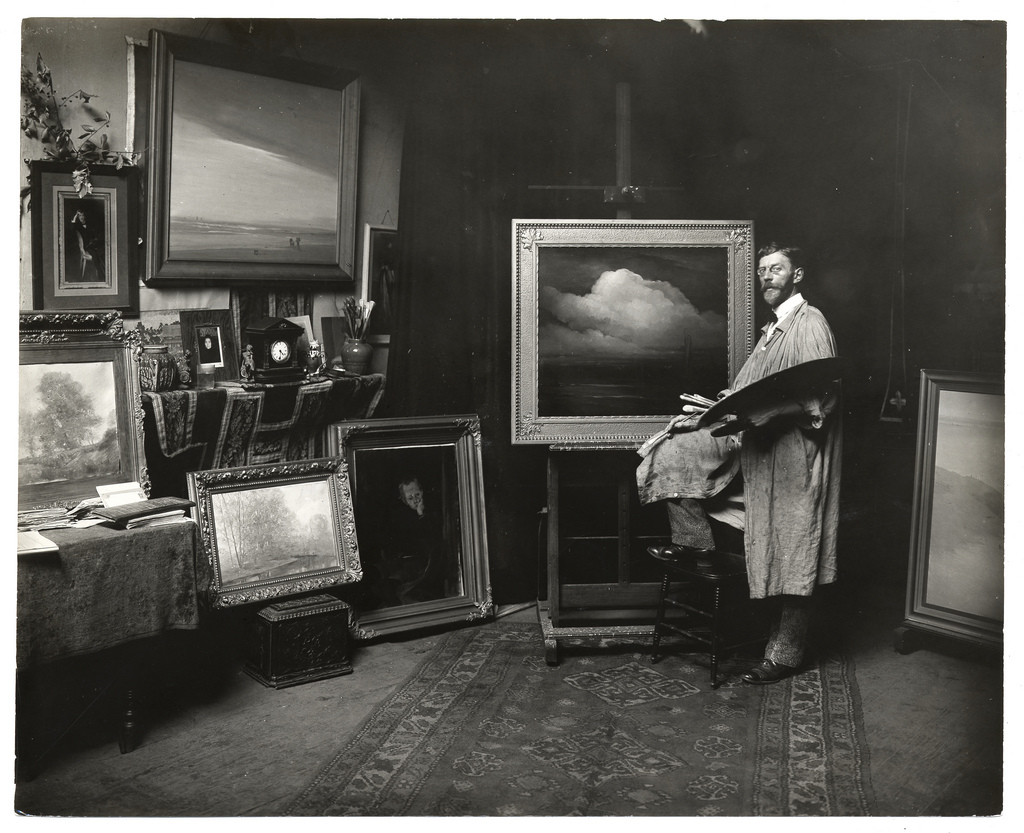
Ten American Painters: The Ten American Painters, generally known as The Ten, resigned from the Society of American Artists in late 1897 to protest the politicalization and commercialism of that group's exhibitions, and their circus-like atmosphere. The Society itself had broken away from the National Academy of Design twenty years early, also as a progressive movement, led by Thomas Eakins, Mary Cassatt, John Singer Sargent, James McNeill Whistler, and Winslow Homer.
The Ten were Childe Hassam, J. Alden Weir, John Henry Twachtman, Robert Reid, Willard Metcalf, Frank Weston Benson, Edmund Charles Tarbell, Thomas Wilmer Dewing, Joseph DeCamp, and Edward Simmons. Abbott Handerson Thayer and Winslow Homer were asked to join the group when it was formed; however, they refused. When Twachtman died in 1902, William Merritt Chase joined in his place.
All of The Ten were active in either New York City or Boston. They were generally considered exponents of Impressionism and established in their careers. In their charter, they agreed to resign from the Society, and hold their own annual exhibition, protesting the Society’s perceived emphasis on “too much business and too little art.” The Society for its part, claimed it was “liberal” with dissenters but some members felt it should stand for “traditional art” and not vacillate with each passing art movement, and thereby let dissenters leave rather than try to appease them.
The Ten held their own annual exhibitions for twenty years, and eventually fell apart from deaths among the members and as their art was deemed reactionary in comparison with urban Realism and other movements which came to the public’s attention.


Dorothea Tanning


___________________
Rare sketches by Tanning and Tanning playing chess with husband Ernst.
Rare sketches by Tanning and Tanning playing chess with husband Ernst.
Subscribe to:
Posts (Atom)


 Posts
Posts


.jpg)